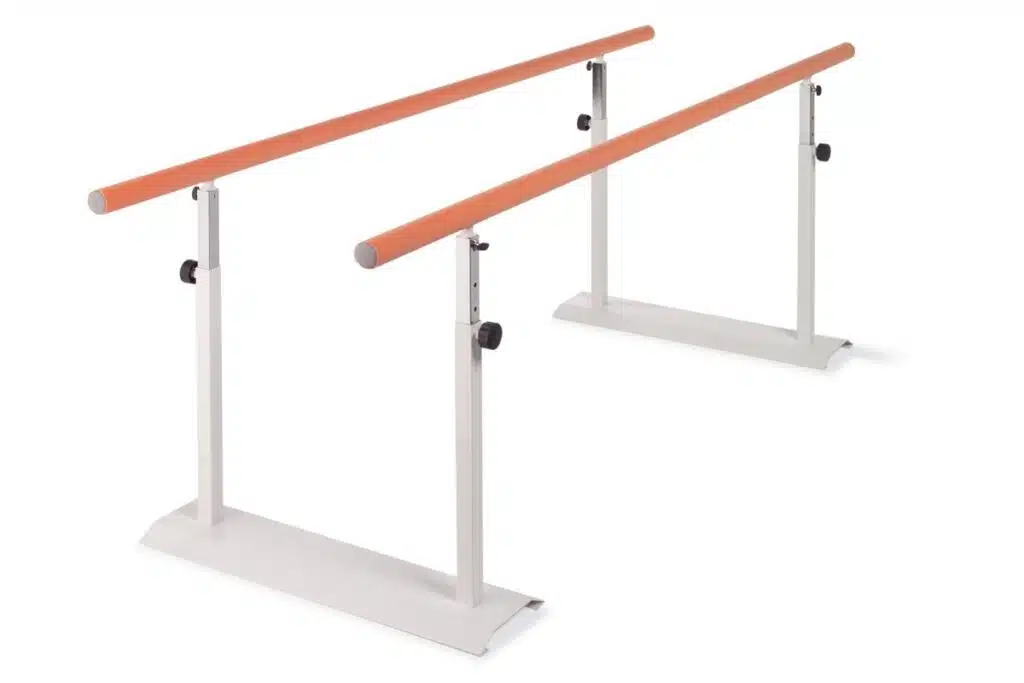
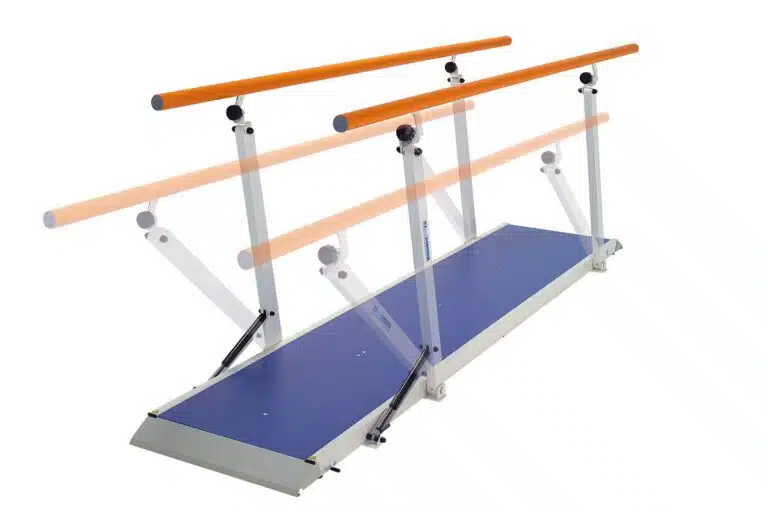
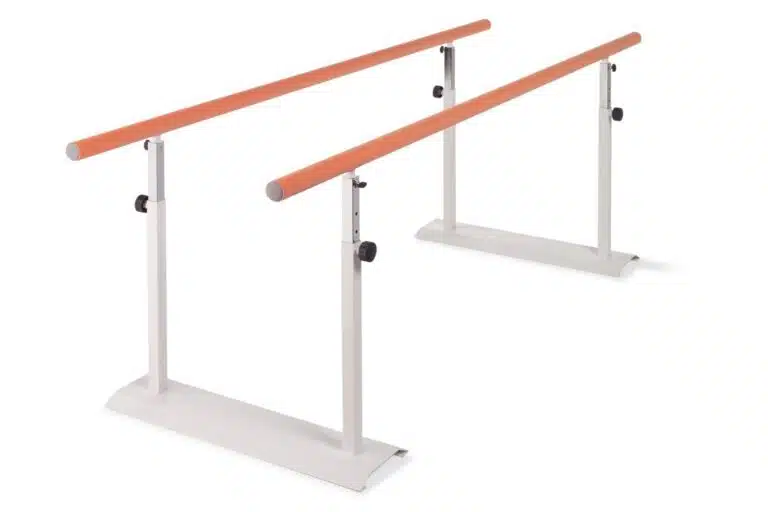
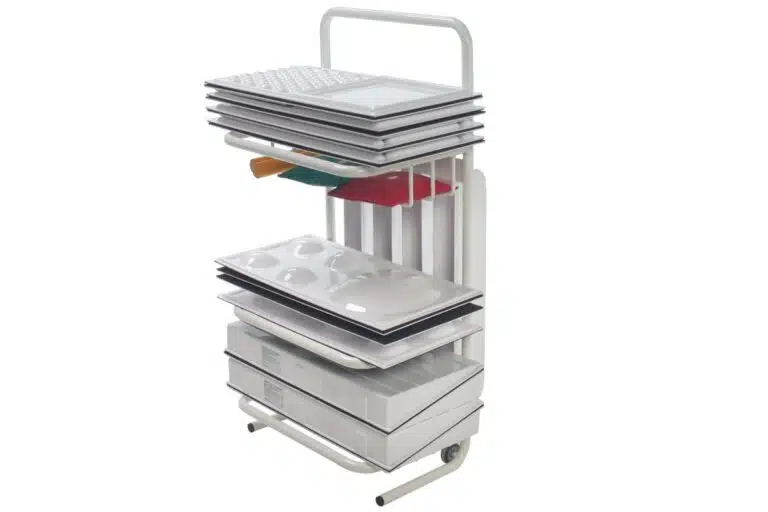
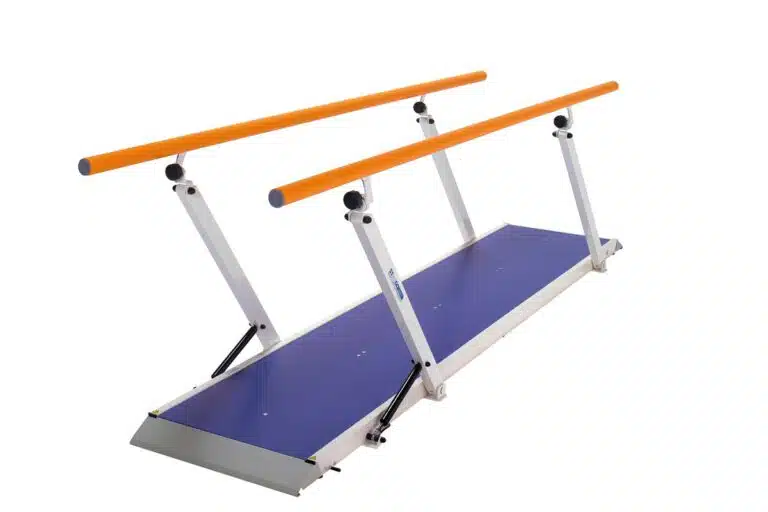
Wesseling supplies parallel bars, training staircases and modular walkpaths for a variety of therapies. The range consists of the Plus-line for adults and children, the Standard-line, training staircases and various modular solutions. This allows you to choose parallel bars or another product that suits your treatment room and the needs of your patients.
What are parallel bars for rehabilitation?
Medical parallel bars are a training aid that allows patients to learn, or relearn, to walk between two handrails. Parallel bars can be used after surgery or injury, but also in neurological rehabilitation, physiotherapy and geriatric care. During therapy, the therapist can walk alongside the patient and provide targeted support.
Using the handrails, the patient determines how much support is needed. As strength, balance and independence improve, their use can gradually be reduced. This makes parallel bars suitable for a variety of therapies and different stages of recovery.
Safe and targeted exercise with parallel bars
Safe use is central to all our parallel bars. The sturdy construction, stable handrails and wear-resistant floor provide reliable support during exercise. Several versions are fitted with handrails made of anti-slip material, so the patient keeps sufficient grip during training. Some Standard models have a steel frame.
The handrails are height-adjustable and can be adapted to the patient’s height and posture. On several models, this height adjustment is done with a telescopic system. A secure locking mechanism prevents parts from unexpectedly coming loose during use and contributes to the safety of the parallel bars.
Parallel bars for adults and children
The parallel bars for adults are designed for professional and intensive use. On the models on the category page, the height of the handrails can be adjusted between 74 and 102 cm. This allows the parallel bars to be set to the right height for the individual needs of the patient.
For young patients, special children’s parallel bars are available. These parallel bars are easily height-adjustable between 64 and 80 cm. This way, children too can work on their gait, muscle strength and mobility in a safe and stable environment.
On some parallel bars, the angle of the bars can also be adjusted. This allows the difficulty of the exercises to be built up step by step and adapted to the progress made during therapy.
Parallel bars of 2.5 metres and 3 metres
The range includes, among others, parallel bars of 2.5 metres and parallel bars of 3 metres. The 2.5-metre version is foldable, making it a practical solution for treatment rooms where the available floor space must be used efficiently. When folded, these parallel bars take up considerably less space.
The 3-metre parallel bars offer more distance to practise several steps in succession. This 3-metre-long product has a steel frame, adjustable handrails and a wear-resistant footboard with ramp. The choice between 2.5 metres and 3 metres depends on the space, the target group and the desired treatment programme.
The width, version and selected options also play a role. Think of a ramp, an extra walking aid, an adjustable platform or additional fixing. This way, all parallel bars can be adapted to their use and the available space.
Training staircases and modular walkpaths
In addition to parallel bars, Wesseling supplies training staircases that allow patients to practise stepping up and down under supervision. The handrails provide support for placing the foot safely and overcoming steps and other obstacles.
With modular walkpaths, stairs, obstacles and a platform can be combined. This creates a flexible system that can be adapted to different exercises and treatment programmes. The therapist can easily expand the training as the patient makes progress.
How much do parallel bars cost?
The price of parallel bars depends on the length, version, adjustment and selected options. Delivery, installation and any additional equipment can also affect the total price. Request a quote or contact Wesseling by e-mail for advice on the most suitable solution.
How does exercising with parallel bars work?
Before starting, the therapist adjusts the height of the handrails to the patient. The patient then walks between the handrails and, under supervision, practises posture, stride length, balance and strength. As mobility improves, support can be reduced and new exercises or obstacles can be added.